Silverado Insights
Silverado regularly hosts video conversations, expert panels, and webinars featuring its research staff and subject-matter specialists. These programs explore emerging policy issues, unpack the findings behind Silverado’s publications, and provide context on key national and economic security trends. Each session offers clear, research-grounded insights for policymakers, practitioners, and the public.

Trump/Xi Meeting on Chinese Exports of Rare Earths
Ahead of the Sept 24 Trump-Xi Summit, Silverado's updated Rare Earths Trade Report that tracks how China has implemented its trade truce commitments, from export controls to yttrium and shifting markets.
With the September 24, 2026 Trump-Xi Summit just days away, Silverado presents the September 2026 Update of Silverado’s Rare Earths Trade Report . Silverado has been following developments closely since last November when the two sides reached a pause to suspend highly restrictive actions on certain rare earths trade for at least one year, and approve export licenses on other rare earths already subject to controls.
Since then, Silverado has been tracking monthly global trade flows to show how the PRC has implemented its commitments under the truce by looking at not only China’s total global exports of rare earth metals, compounds, and magnets, but also those subject to export controls. We have also looked at trends specific to certain minerals with the highest levels of import dependency and least alternatives, such as yttrium, and how China has shifted export markets during this time period.
In broad terms, China has exported just enough rare earth compounds and metals this year to keep the US-CN bilateral pause intact, but export levels are still low by objective and historical levels, change month-to-month, and there is no certainty about how or if this will change based on larger geopolitical and economic considerations. At the same time, China is using the processed minerals to produce rare earth magnets at home for export to the global market, capturing the highest value segments of the rare earth supply chain for itself and consolidating control over the processing and magnet production nodes. This strategy is intended to keep China in control of who gets what and when, which undermines companies’ ability to predict supply disruptions and limits their alternatives.
The September 2026 data, presented below, show these trends continuing. The Summit will be an important platform for the U.S. to secure a continued suspension of China’s extra-territorial export control regime on rare earths that threatens to disrupt global supply chains, as well as detailed and specific commitments by China to resume exports of export-controlled rare earths like yttrium at or near historical levels.
The Rare Earths Trade Report: September 2026 Update
Report by: Meagan Reid , Andy David , and Andrew Knipe
China continued to heavily restrict global exports of export-controlled rare earth compounds and metals in August 2026, according to Silverado’s most recent Rare Earth Trade Report . U.S.-bound shipments of export-controlled compounds and metals decreased sharply in August, while exports to Japan remained at zero for the third consecutive month. Korea remained the largest export destination, while the European Union was the second largest destination. Meanwhile, China continued to export large volumes of rare earth permanent magnets globally, though year-to-date shipments to the United States remained below 2024 levels.
1. China’s exports of export-controlled rare earth compounds and metals to the United States fell in August 2026.
China shipped approximately 6 metric tons of export-controlled rare earth compounds and metals to the United States in August 2026, down from 29 metric tons in July. This remained far below the volumes that regularly reached the United States before the April 2025 export controls.
The August shipments were also highly concentrated. Nearly all were lutetium oxide, which rebounded after China reported no lutetium oxide exports in July. The United States remains China’s largest export destination for lutetium oxide, and U.S. imports of the material are currently on pace to reach typical historical levels despite substantial month-to-month volatility. However, the trade data also indicate that access may vary significantly among individual U.S. companies.
The situation remains considerably tighter for several other controlled rare earths. China has not exported dysprosium to the United States since April 2025, although some U.S. imports have subsequently arrived from the European Union and Malaysia. China’s global dysprosium exports themselves fell sharply in August, dropping to only 1 metric ton after reaching near-historical levels in July.

2. China’s exports of export-controlled rare earth compounds and metals to Japan remained at zero for the third consecutive month in August 2026, while shipments to South Korea remained elevated.
The effects of China’s export controls continue to vary substantially across major trading partners. In August, South Korea remained the largest destination for China’s exports of controlled rare earth compounds and metals, while exports to Japan remained at zero for the third consecutive month.
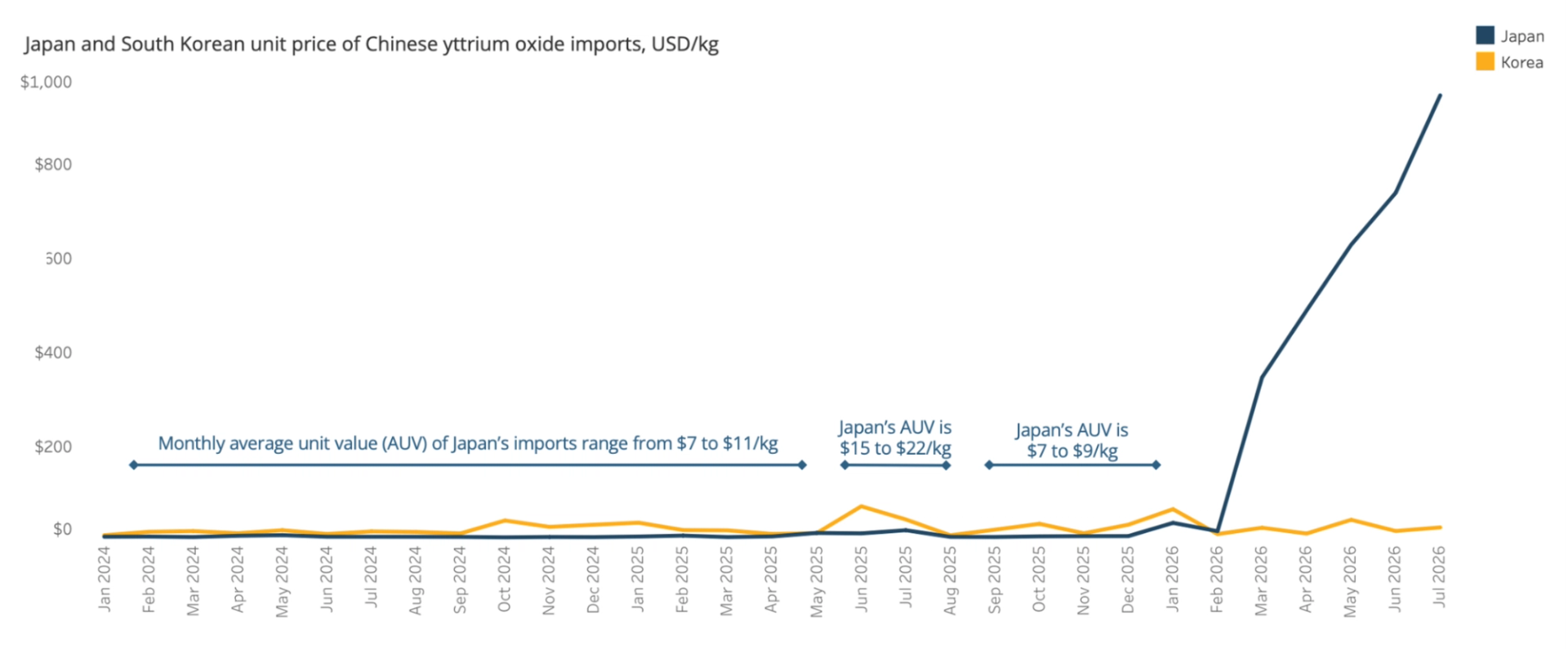
The difference is particularly visible in shipments of yttrium. China reported no direct yttrium exports to Japan in August 2026, while South Korea remained China’s largest destination for the material. Japanese and South Korean import data reinforce this divergence. South Korea reported its highest level of yttrium oxide imports from China in July 2026, while Japanese imports remained well below earlier levels. Alternative suppliers also have not fully filled the gap created by declining Chinese supply to Japan
Japan’s official import statistics indicate that the country continued to receive some Chinese-origin yttrium, but at a significantly higher cost and lower volume. Following the additional Chinese export controls, the unit value of Japan’s imports of Chinese yttrium oxide rose sharply, while South Korean import prices remained comparatively stable.
3. China continues to ship large volumes of rare earth magnets globally, though the United States remains an exception among major destinations in August 2026.
China’s exports of rare earth permanent magnets, which are only partially covered by the April 2025 export controls, tell a different story from controlled rare earth compounds and metals. China’s exports fell after the implementation of export controls, but recovered to more typical levels by July 2025 and have remained substantial since then.
However, among major destinations, the United States was the only major market to receive fewer rare earth magnets from China during January to August 2026 than during the same period in 2024. China’s shipments to the United States briefly rose above the 2024 monthly average in July 2026 (for the first time since October 2025), but fell back well below the average in August 2026. This suggests that July’s increase did not mark a sustained return to pre-control trade patterns.

4. Total U.S. imports of sintered neodymium-iron-boron (NdFeB) permanent magnets by weight were lower in H1 2026 than in H1 2024, though a modest increase in imports from other countries (particularly Japan) partially offset the decline in imports from China. The number of magnets imported increased, as imports appear to be shifting toward smaller magnets.
U.S. imports of sintered neodymium-iron-boron (NdFeB) permanent magnets, by weight, remained below 2024 levels from January through July 2026. Increased imports from other suppliers—particularly Japan—helped offset some of the decline from China, while the European Union and Southeast Asian suppliers have also increased their role. At the same time, the number of magnets imported into the United States increased, suggesting that imports are shifting toward smaller magnets.
There are also important differences among suppliers. U.S. imports from China appear increasingly moving toward smaller magnets, while imports from Japan and the European Union in 2026 appear to consist of larger magnets, with substantially more weight relative to the number of individual magnets imported. Japanese shipments in particular appear to have shifted toward larger NdFeB magnets compared with 2024.

Continue the conversation / Share your perspective with other readers following this issue.
Leave a comment on Substack


Related Material

Global Industrial Robot Trade: Q2 2026
Sep 01, 2026
China’s Global Exports of Rare Earths: August 2026 Update
Aug 31, 2026

The “China Threat” Lists Hadn’t Been Talking
Aug 18, 2026

From Minerals to Robots: Recent Research on China’s Role in Global Supply Chains
Aug 12, 2026

Fusion Update: 2026 Supply-Chain and Global Industry Insights
Aug 06, 2026
China’s Yttrium Exports Remained Depressed in Q2 2026
Jul 28, 2026
Related Publications
Explore more insights and analysis from our research team.
Silverado Policy Accelerator • Sep 22, 2026
Rare Earth Trade Report (September 2026)China kept tight curbs on rare earth compound and metal exports in Aug 2026; US and Japan shipments stayed low while magnet exports recovered.

Silverado Policy Accelerator • Jul 28, 2026
Silverado Submits Comments to USTR Regarding the Proposed U.S.-China Board of TradeSilverado submitted comments to USTR regarding the Operation of a Mechanism to Promote Reciprocal and Managed Trade with China.

Silverado Policy Accelerator • Jun 26, 2026
China's Global Exports of Rare Earths: June 2026 UpdateChina’s exports of rare earth compounds and metals to the United States have been very limited since China implemented its April 2025 export controls