Silverado Insights
Silverado regularly hosts video conversations, expert panels, and webinars featuring its research staff and subject-matter specialists. These programs explore emerging policy issues, unpack the findings behind Silverado’s publications, and provide context on key national and economic security trends. Each session offers clear, research-grounded insights for policymakers, practitioners, and the public.

China’s Yttrium Exports Remained Depressed in Q2 2026
Silverado Policy Accelerator Quarterly Yttrium Update.
Key takeaways
China’s export restrictions on yttrium continue to significantly limit global yttrium supply. While there was some improvement in Chinese exports in late 2025, the more stringent restrictions on shipments to Japan (introduced in early 2026) led to a renewed curtailment in global trade flows. The most consistent post-export control shipment volumes were to the European Union and Korea, though exports to those destinations were not enough to offset the decline in shipments to other regions.
Introduction
China’s exports of rare earth compounds and metals subject to export controls fell substantially following the implementation of China’s export controls in April 2025 and remain low by historical standards, as detailed by Silverado in its monthly rare earth dashboard . Yttrium exports accounted for the largest volume of exports (in Chinese tariff lines fully covered by export controls) prior to April 2025 and were significantly impacted by Chinese export controls. This post, a supplement to the monthly rare earth dashboard, provides additional analysis on China’s yttrium exports.
The data in this post differs from the monthly rare earth dashboard in a few ways:
- The dashboard provides more long-term historical data.
- The data are aggregated on a quarterly basis, making it easier to identify long-term trends.
- Unlike the Silverado rare earth dashboard, all data are also converted to yttrium oxide equivalent, allowing for comparison of the yttrium content of exported products (see note below).
- One additional yttrium product, other yttrium compounds, is included in the data here, but is not included in the yttrium breakout in the monthly dashboard since it is only partially covered by export controls. (There is only a small volume of trade in this product.)
Note: Rare earths are produced and sold in various forms, such as metals, oxides, and carbonates, as well as combined with other rare earths or chemical compounds. These different forms have varying concentrations of the specific rare earth element. For example, yttrium accounts for 79 percent of the weight of yttrium oxide, but only 50 percent of the weight of yttrium carbonate. In order to measure mineral volumes on a comparable basis, therefore, they are often converted to the rare earth oxide equivalent (in this case yttrium oxide equivalent). While it is not possible to do this conversion in Silverado’s monthly dashboard due to basket categories that contain more than one product, for this yttrium-specific analysis the data are converted to yttrium oxide equivalent to better compared the amount of yttrium traded.
Export trend
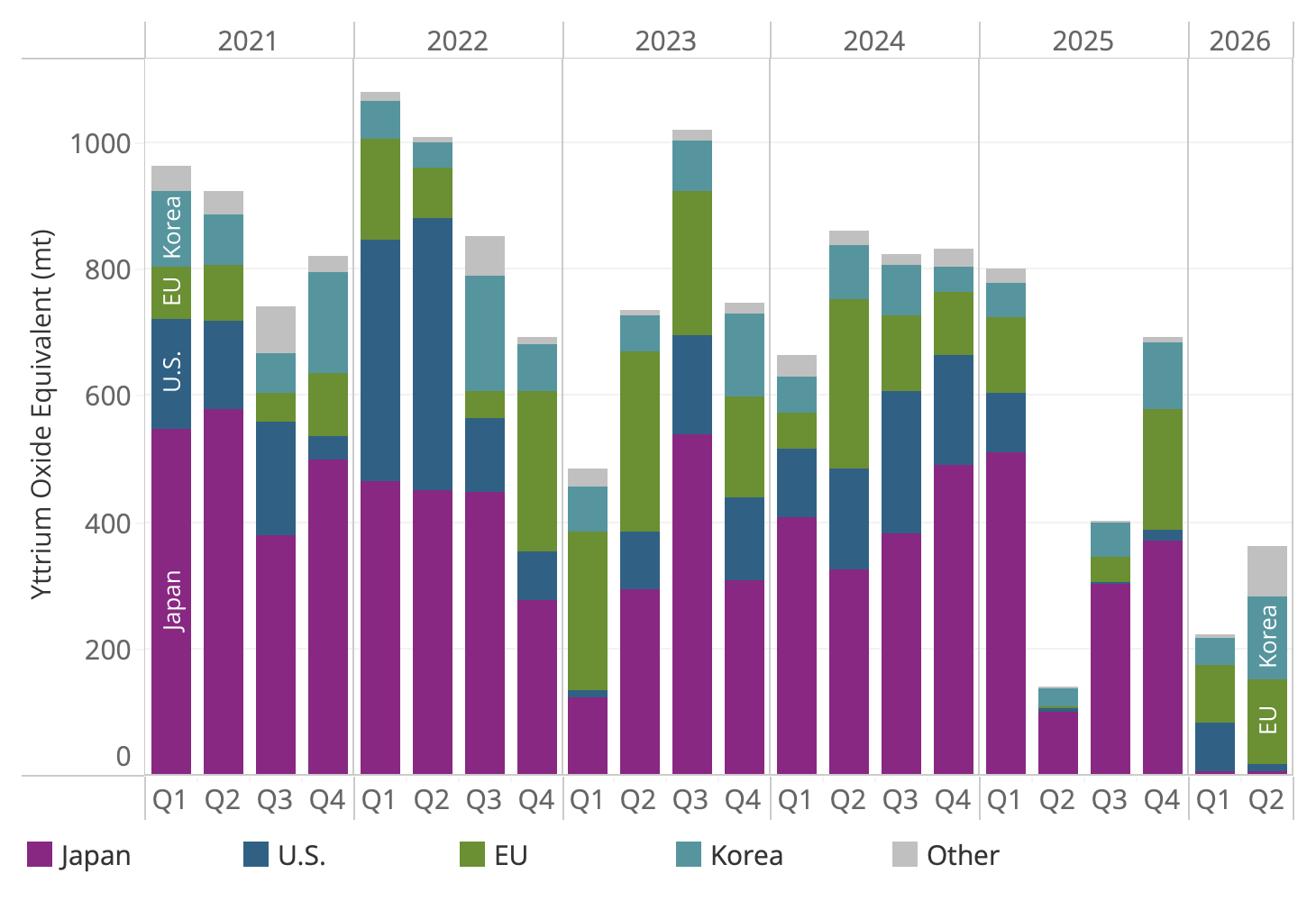
China’s yttrium exports—as measured by metric tons of yttrium oxide equivalent—significantly declined following China’s implementation of export controls in April 2025 (figure 1). China’s yttrium exports increased from Q2 2025 to close to typical historical levels by Q4 2025. 1 In early 2026, however, China imposed additional restrictions on exports of dual-use goods to Japan and reportedly slowed approvals of new export licenses. 2 This led to a sharp decline in exports to Japan and a fall in overall exports, since Japan was the largest export destination in the second half of 2025. 3
Figure 1: China’s yttrium exports, by destination, metric tons of yttrium oxide equivalent
Exports by country
China’s yttrium exports historically went primarily to four destinations: Japan, the United States, the European Union, and Korea (figures 1 and 2). After April 2025, shipments to the United States were very limited, while there was significant recovery in the supply to the other three major partners in the third and fourth quarters of 2025. In 2026, with the implementation of more stringent controls on exports to Japan, shipments to Japan fell sharply. Exports to the United States also remained low in the first half of 2026, with the exception of a brief one-month uptick in exports in March 2026. On the other hand, the European Union and Korea received the most volume in the first half of 2026. In the second quarter of 2026, there was also an increase in exports to Vietnam and Russia. 4
Figure 2: China’s yttrium exports to top pre-export control destinations, metric tons of yttrium oxide equivalent

Exports by product
Yttrium oxide historically accounted for the largest share of yttrium exports, followed by yttrium carbonate (figure 3). Following the implementation of export controls, China primarily exported yttrium oxide, with unalloyed yttrium metal accounting for the second largest volume of yttrium exports. China only exported a minimal amount of yttrium carbonate following the implementation of export controls. 5
Figure 3: China’s yttrium exports, metric tons of yttrium oxide equivalent

Footnotes
- Global Trade Tracker database.↩
- Ministry of Commerce of the People’s Republic of China, 商务部公告2026年第11号 公布将20家日本实体列入出口管制管控名单, February 24, 2026, https://www.mofcom.gov.cn/zwgk/zcfb/art/2026/art_b5159a773124428a9813884015d1b8b3.html; Ministry of Commerce of the People’s Republic of China, 商务部公告2026年第12号 公布将20家日本实体列入关注名单, February 24, 2026, https://www.mofcom.gov.cn/zwgk/zcfb/art/2026/art_bac18400512d408a8d4c2f964e36ac11.html; Ministry of Commerce of the People’s Republic of China, 商务部公告2026年第1号 关于加强两用物项对日本出口管制的公告, January 6, 2026, https://www.mofcom.gov.cn/zwgk/zcfb/art/2026/art_8990fedae8fa462eb02cc9bae5034e91.html; Shunsuke Tabeta and Kentaro Shiozaki, “China Now Curbs Civilian-Use Rare-Earth Exports to Japan,” Nikkei Asia, January 9, 2026, https://asia.nikkei.com/business/markets/commodities/china-now-curbs-civilian-use-rare-earth-exports-to-japan; Jon Emont, “China Deprives Japan of Rare-Earths Supply, Escalating Dispute,” The Wall Street Journal, January 8, 2026, https://www.wsj.com/world/asia/china-deprives-japan-of-rare-earths-supply-escalating-dispute-41e7750c↩
- Global Trade Tracker database.↩
- Global Trade Tracker database.↩
- Global Trade Tracker database.↩

Related Material
Trump/Xi Meeting on Chinese Exports of Rare Earths
Sep 23, 2026

Global Industrial Robot Trade: Q2 2026
Sep 01, 2026
China’s Global Exports of Rare Earths: August 2026 Update
Aug 31, 2026

The “China Threat” Lists Hadn’t Been Talking
Aug 18, 2026

From Minerals to Robots: Recent Research on China’s Role in Global Supply Chains
Aug 12, 2026

Fusion Update: 2026 Supply-Chain and Global Industry Insights
Aug 06, 2026
Related Publications
Explore more insights and analysis from our research team.
Silverado Policy Accelerator • Sep 22, 2026
Rare Earth Trade Report (September 2026)China kept tight curbs on rare earth compound and metal exports in Aug 2026; US and Japan shipments stayed low while magnet exports recovered.
Silverado Policy Accelerator • Jul 28, 2026
Silverado Submits Comments to USTR Regarding the Proposed U.S.-China Board of TradeSilverado submitted comments to USTR regarding the Operation of a Mechanism to Promote Reciprocal and Managed Trade with China.

Silverado Policy Accelerator • Jun 26, 2026
China's Global Exports of Rare Earths: June 2026 UpdateChina’s exports of rare earth compounds and metals to the United States have been very limited since China implemented its April 2025 export controls