Assessing U.S. Competitiveness in Durable Goods Manufacturing: Investment Trends
The United States is focused on accelerating and incentivizing the growth of domestic manufacturing, which is a cornerstone of U.S. economic competitiveness.
Published by: Silverado Policy Accelerator • Aug 21, 2025
The United States is focused on accelerating and incentivizing the growth of domestic manufacturing, which is a cornerstone of U.S. economic competitiveness. Assessing the current state of U.S. manufacturing competitiveness is critical in these efforts to support domestic manufacturing.
These assessments can inform policymakers as they design incentives for companies to invest in domestic manufacturing, whether that is in traditional industries such as steel and aluminum or rapid-growth industries such as servers and data center equipment. Silverado has conducted in depth analyses of many of these industries (e.g., aluminum , critical minerals , semiconductors , servers , steel , and vehicles and will continue to do so, but in a new series of posts will also examine the competitiveness of the manufacturing sector in the United States more broadly.
The first posts in this new series will examine the extent to which U.S. durable goods[1] manufacturers have invested in the equipment and technology that are key components of long-term competitiveness. U.S. durable goods manufacturing has stagnated since the 2008 financial crisis, with little growth—and in some cases even declines—across key metrics such as production (real value), production capacity, capacity utilization, employment, and productivity. There are broader economic factors that underlie some of this stagnation—from the decline in oil prices[2] in 2014 to the COVID-19 pandemic. Another possible contributing factor, however, is a change in the relative competitiveness of certain segments of the U.S. durable goods manufacturing sector.[3]
This initial post examines data from the Federal Reserve and Bureau of Economic Analysis on the age and stock of manufacturing equipment for durable goods producing industries. Additional data sources that cover these topics and more specific sector and equipment-type breakdowns will be examined in subsequent posts.
The data covered today, while only a small piece of the U.S. durable goods manufacturing picture, indicate relatively low levels of investment in U.S. manufacturing capabilities since 2008. These trends are not unique to the United States as business investment has also lagged in many other developed economies.[4] But the investment trends may potentially impact U.S. competitiveness against countries such as China, which substantially increased its manufacturing base since the financial crisis.[5] There are three key takeaways from the data on U.S. investment:
Durable goods production capacity has stagnated
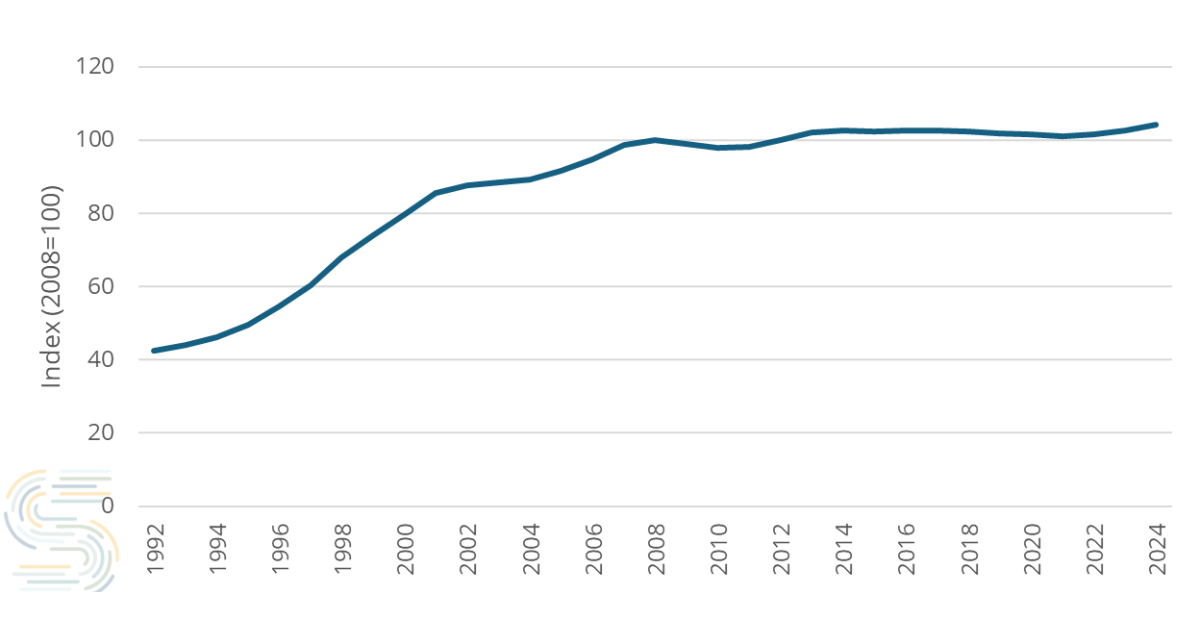
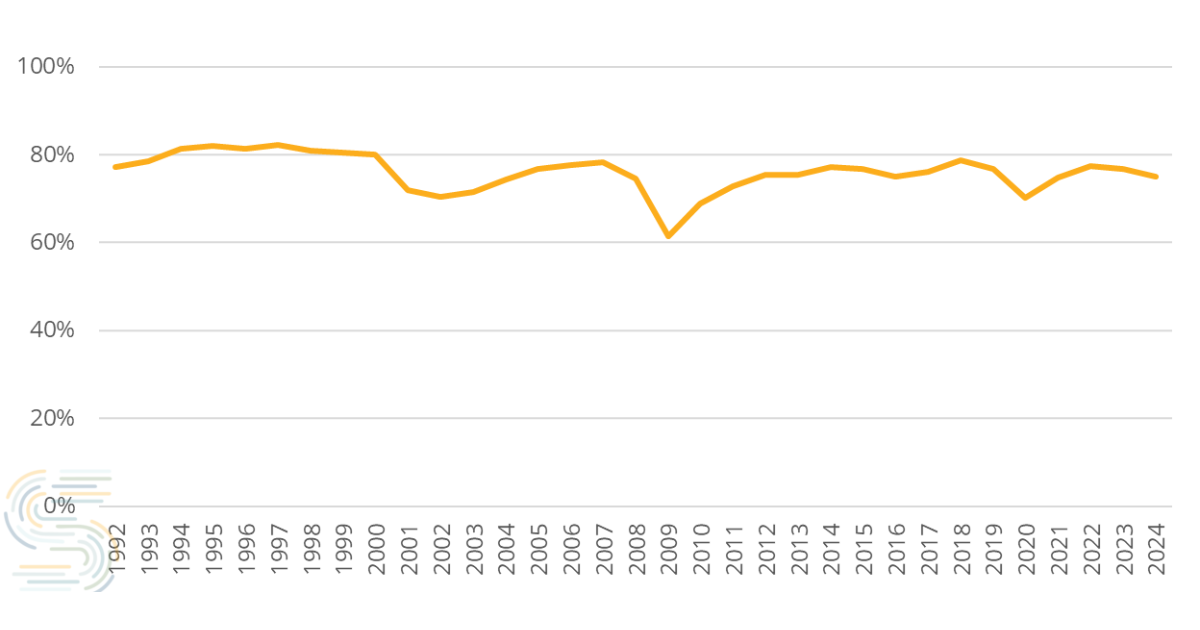
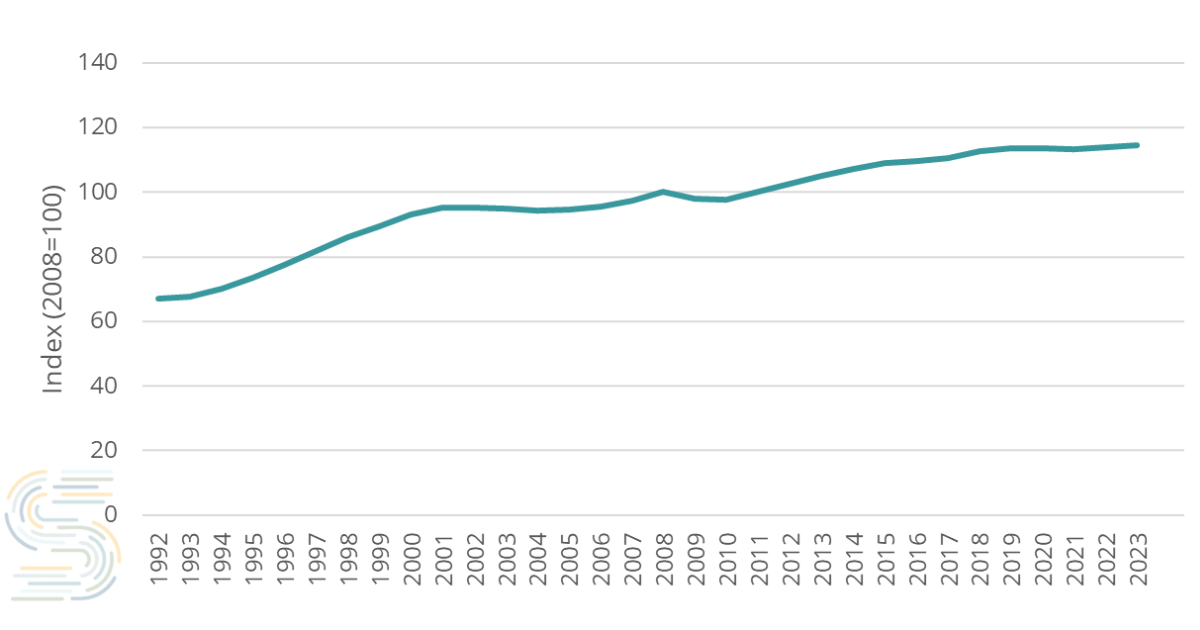
U.S. durable goods production capacity, according to data from the Federal Reserve, stagnated after the financial crisis and in 2024 was only 4 percent higher than in 2008 (figure 1).[6] This lack of new capacity reflects low capacity utilization rates, which remained below 80 percent throughout the entire post-financial crisis period (figure 2).[7] With low capacity utilization rates, firms do not have the economic incentives and potential returns on investment that would lead to major new investments
Figure 1: Manufacturing capacity, U.S. durable goods sector, index [8]
Figure 2: Capacity utilization rates, U.S. durable goods sector [9]
Durable goods manufacturers’ investment in equipment was weak in recent years
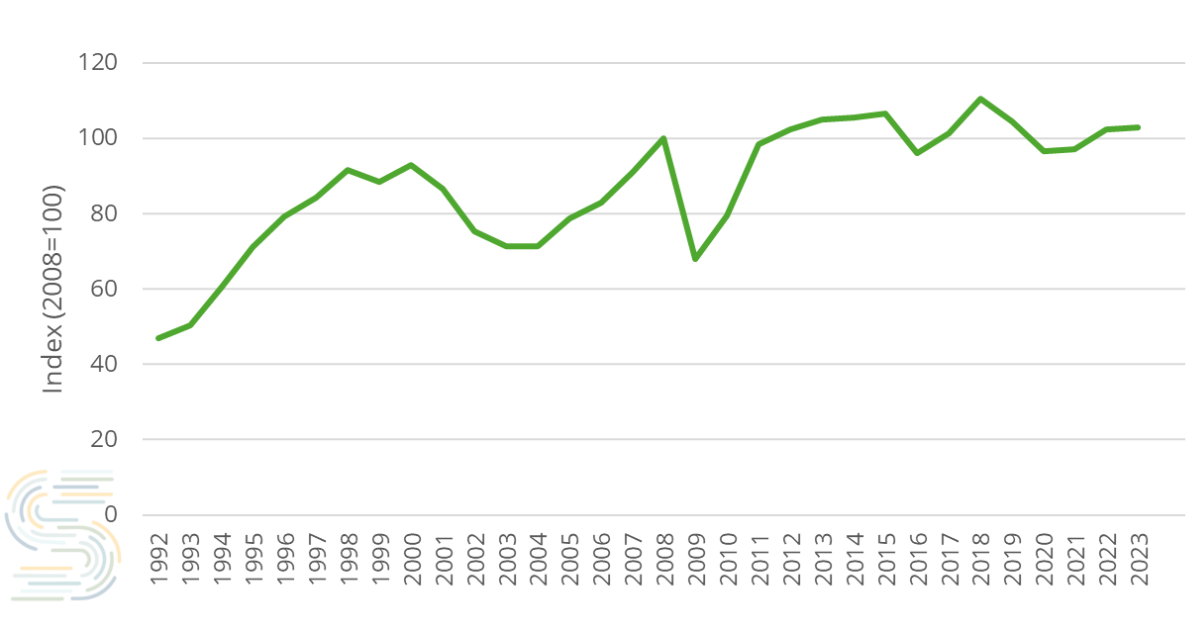
U.S. durable goods manufacturers’ domestic investment in equipment, while initially rebounding to above pre-financial crisis levels, slowed after 2015—investment was below 2014–15 levels for all but one year during 2016–23 (figure 3). This flattening of the level of investment is reflected in data on the stock of factory equipment, which only slightly increased after 2015 (figure 4).[10]
Figure 3: Investment in private equipment, U.S. durable goods sector, chain-type quantity index [11]
Figure 4: Net stock of private equipment, U.S. durable goods sector, chain-type quantity index [12]
The age of equipment in U.S. durable goods factories is near historic highs
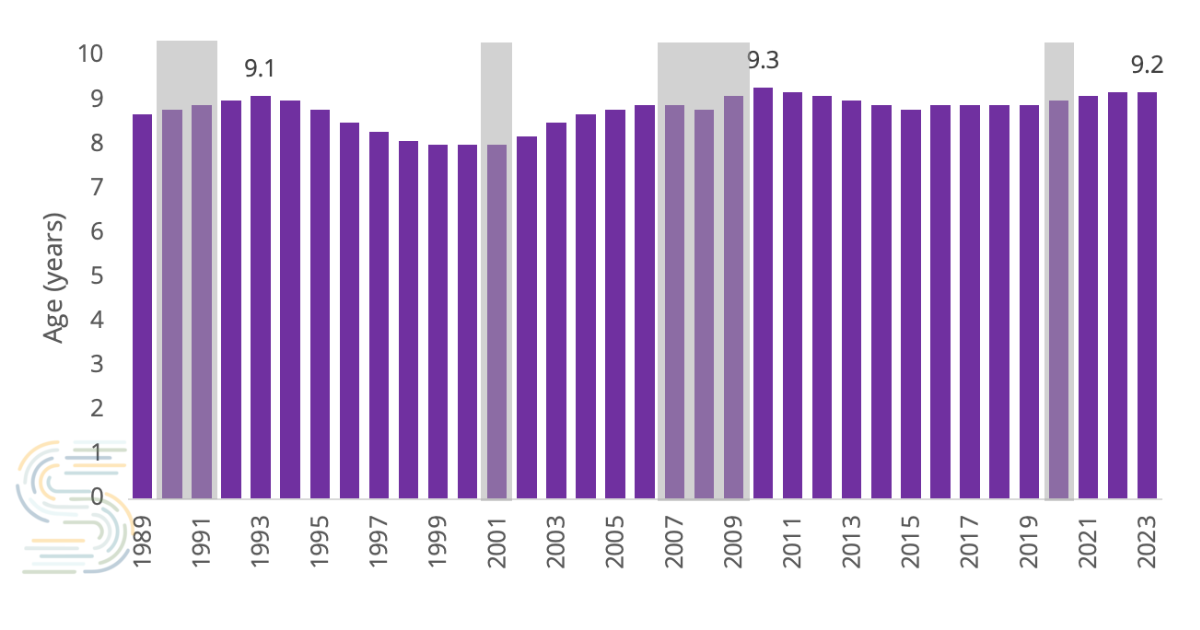
The average age of equipment in U.S. durable goods factories was 9.2 years old in 2022 and 2023, the highest since 2011 (Figure 5). While this average equipment age is not unheard of in the last three decades, previous peaks were closer to the end of recessions.
Figure 5: Current-cost average of private equipment, U.S. durable goods sector (years with a U.S. recession are in gray) [13]
Footnotes
[1] Durable goods are those designed to last at least three years and include metals, machinery, aircraft, vehicles, semiconductors, computers, medical devices, household appliances, and a range of other products.
[2] André Barbé, Andrew David, and Alan Fox, “Special Topic: Effects of Declining Crude Petroleum and Natural Gas Prices on U.S. Sectoral Trade,” Investigation No. 332-345, Publication 4641, Shifts in U.S. Merchandise Trade , 2015 (U.S. International Trade Commission, 2016), https://www.usitc.gov/research_and_analysis/trade_shifts_2015/specialtopic.htm.
[3] For additional background on factors of competition, the following paper covers many of the key aspects of competitiveness (though it focuses on firm-level and not industry-level competitiveness): Andrew David, Mitchell Semanik and Mihir Torsekar Framework for Analyzing the Competitiveness of Advanced Technology Manufacturing Firms, Working Paper ID-057 (U.S. International Trade Commission, 2018), https://www.usitc.gov/publications/332/working_papers/competitiveness_of_advanced_technology_manufacturing_firms_id_18_057_091718.pdf.
[4] OECD, OECDEconomic Outlook: Tackling Uncertainty, Reviving Growth , Volume 2025/1, No. 117, OECD Economic Outlook (OECD Publishing, 2025), https://doi.org/10.1787/83363382-en; Christine Lewis, Nigel Pain, Jan Stráský, and Fusako Menkyna, Investment Gaps after the Crisis , OECD Economics Department Working Papers 1168, vol. 1168, OECD Economics Department Working Papers (OECD, 2014), https://doi.org/10.1787/5jxvgg76vqg1-en.
[5] Alexander Al-Haschimi and Tajda Spital, “The Evolution of China’s Growth Model: Challenges and Long-Term Growth Prospects,” ECB Economic Bulletin , no. 5/2024 (July 2024), https://www.ecb.europa.eu/press/economic-bulletin/articles/2024/html/ecb.ebart202405_01~a6318ef569.en.html; National Bureau of Statistics of China, “Fixed Asset Investment Data,” n.d., accessed August 14, 2025, https://www.stats.gov.cn/english/.
[6] U.S. GDP significantly increased during this same time period. Board of Governors of the Federal Reserve System, “G.17: Industrial Production and Capacity Utilization,” n.d., accessed August 7, 2025, https://www.federalreserve.gov/DataDownload/Choose.aspx?rel=G17; U.S. Bureau of Economic Analysis, “Real Gross Domestic Product,” Federal Reserve Bank of St. Louis, July 30, 2025, https://fred.stlouisfed.org/series/GDPC1.
[7] Board of Governors of the Federal Reserve System, “G.17: Industrial Production and Capacity Utilization.”
[8] Board of Governors of the Federal Reserve System, “G.17: Industrial Production and Capacity Utilization.”
[9] Board of Governors of the Federal Reserve System, “G.17: Industrial Production and Capacity Utilization.”
[10] U.S. Bureau of Economic Analysis, “Fixed Assets Accounts Tables,” n.d., accessed August 7, 2025, https://apps.bea.gov/iTable/?ReqID=10&step=2#eyJhcHBpZCI6MTAsInN0ZXBzIjpbMiwzLDNdLCJkYXRhIjpbWyJUYWJsZV9MaXN0IiwiMTA4Il0sWyJTY2FsZSIsIjAiXSxbIkZpcnN0X1llYXIiLCIxOTUwIl0sWyJMYXN0X1llYXIiLCIyMDIzIl0sWyJTZXJpZXMiLCJBIl1dfQ==.
[11] U.S. Bureau of Economic Analysis, “Fixed Assets Accounts Tables.”
[12] U.S. Bureau of Economic Analysis, “Fixed Assets Accounts Tables.”
[13] U.S. Bureau of Economic Analysis, “Fixed Assets Accounts Tables.”