Key Engagements at the 62nd Annual Munich Security Conference
12th Annual Cybersecurity Conference
Event Details

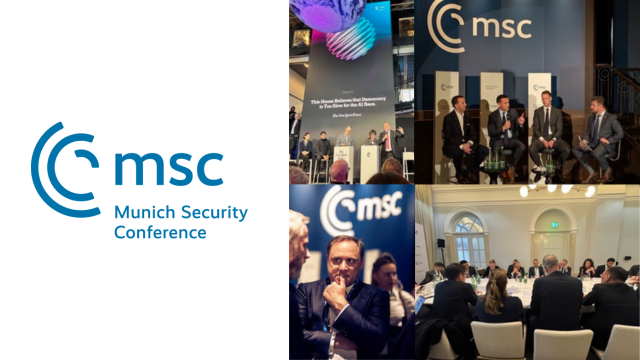
The Munich Security Conference continues to serve as one of the most important convening points for leaders addressing the intersection of national security, technology, and geopolitics. This year’s discussions highlighted the growing importance of cybersecurity cooperation, technological competition, and resilient supply chains among democratic nations.
Across several engagements throughout the week, our Silverado Policy Accelerator team contributed to conversations focused on strengthening transatlantic partnerships and addressing emerging strategic challenges.
A central theme of the conference was the evolution of cyber conflict and the role of governments in confronting increasingly sophisticated malicious actors. At the Munich Cybersecurity Conference, Silverado’s Marc Raimondi, moderated a panel on offensive cyber operations, “Command Control, Really? Confronting the Illusion of Deterrence in the Age of Relentless Cyber Threats,” that brought together a group senior cyber leaders from the EU and United States to discuss an improved transnational cooperation to target both state and criminal actors that exploit cyber space. Participants included FBI Assistant Director Brett Leatherman, Silverado Strategic Council member Sandra Joyce, Bavarian Chief Prosecutor Thomas Goger, and Switzerland’s Cybersecurity Director Florian Schutz. The discussion examined how governments are adapting their strategies to deter and disrupt cyber threats, as well as the legal and operational frameworks required to hold malicious actors accountable in an increasingly contested digital environment.
Artificial intelligence and its growing significance in global strategic competition was featured prominently throughout the conference’s agenda. Dmitri Alpervotich , Co-Founder and Co-Chair of Silverado, participated in a New York Times debate examining whether democratic systems or authoritarian governments are better positioned to win the global race for artificial intelligence leadership. The debate explored competing advantages, including the role of open innovation ecosystems, access to talent, regulatory frameworks, and state-directed industrial policy.
Convening leaders across sectors remains a core component of engagement at the Munich Security Conference. This year, we hosted the Fifth Annual Silverado Transatlantic Leadership Reception, which brought together ambassadors, senators, executive branch officials, and their international counterparts, including foreign ministers, cabinet members, and global business leaders. The reception provided an opportunity to strengthen relationships across the transatlantic community and facilitate informal dialogue on shared economic and security priorities.
International cooperation in cyber law enforcement was another focus of the week’s discussions. At an official Munich Security Conference side event, Marc Raimondi moderated a panel titled, “Establishing the Frame: Cyber as Power Projection” on transnational cyber cooperation in confronting malicious cyber actors. The conversation featured FBI Assistant Director for Cyber Brett Leatherman, the Netherlands’ cyber law enforcement lead Stan Duijf and David Lashway of Sidley Austin. Panelists discussed the operational challenges of investigating cybercrime that spans multiple jurisdictions and emphasized the importance of intelligence sharing, coordinated enforcement actions, and stronger international legal frameworks to improve collective response capabilities.
The conference also highlighted lessons emerging from Ukraine’s defense against Russia’s invasion, particularly in the area of rapid technological adaptation. Dmitri led an official Munich Security Conference side event titled “Innovation Under Fire: Ukraine’s Battlefield Innovations and Lessons for NATO.” The discussion included Andrey Liscovich, founder of the Ukrainian Defense Fund, and Greta Tuckute, a senior NATO representative from Lithuania. The panel explored how Ukraine has rapidly integrated new technologies and operational approaches on the battlefield and what these innovations may mean for NATO’s future defense planning.
Finally, Dmitri participated in a Munich Security Conference roundtable titled “Sync or Sink: Rethinking Partnerships in Critical Raw Materials and Technologies.” The discussion examined the strategic implications of the growing rivalry between the United States and China in critical minerals supply chains. As demand for advanced technologies accelerates, securing access to key raw materials will remain central to both economic security and technological leadership. Participants emphasized the need for deeper collaboration among allied nations to diversify supply chains and strengthen resilience in critical resource markets.
Together, these discussions underscored the interconnected nature of today’s security challenges and the importance of sustained cooperation among democratic partners to address them effectively.
Search
Event Host
Silverado Policy Accelerator


Event Speakers

Related Content

Silverado’s Semiconductor and Semiconductor Manufacturing Equipment Portfolio
Mar 10, 2026

Silverado Hosts 3rd Annual Tech Policy Lunch Ahead of Munich Cyber Security Conference
Feb 12, 2026

Silverado Comments on Sec. 232 Investigation of Imports of Polysilicon
Jan 08, 2026
2024 Trends in Global Semiconductor Trade
Sep 23, 2025

Silverado Submits Testimony for USMCA Review
Dec 03, 2025